


The other day, I was showing a prospective family around the school and Will's name came up in conversation. 'We've heard of him,' they said. 'Our friend's daughter says he is the best teacher she ever had.'
Will started teaching in the 1980's and has worked in schools in New Hampshire, Colorado, and Michigan (teaching students in grades K through 12). He has taken his passion for education outside the classroom: he has run his own educational game company, taught teaching methods and poetry as an adjunct professor at the UM, supervised student teachers, and started a tutoring and writing services business. He is a published poet and the father of two amazing girls (one an SK alumna).
Will's goals for his students are that they should be self-motivated, playful, energetic learners and thinkers, exploring for the joy of exploration, internally motivated, confident, with a solid skill-set to take them into the future. I always say to families who are interested in SK that our goal is for each child to be the most - and best - themselves that they can possibly be. That is Will's focus and intent. So how does he get there?
Much of the work that is done in Will's classroom is project-based learning and exploration. It engages the students' own ideas and sense of direction so that they are passionate themselves about the journeys they make. 'As a teacher,' he told me, 'I know I'm doing a good job if I'm in the background, as a guide, I get to start the ball and watch them run with it, roll with it, play with it...' His role as a facilitator is to respond to the energy his students bring into the classroom. Along the way he encourages, gives feedback, develops skills. 'I help them see that there is a more difficult road ahead - one that's worth taking - you need better shoes. No cop-outs.' The result is that he has students who clamor to come in from recess so that they can continue working and take their activities further. When they find they have five minutes of time they ask to bring out other work: 'Yay, I get to work on math!'
Everything, from working on spelling to major units like the hybrid car project, involves choices that the children can buy into on their own terms, and different facets of skill-training and higher level thinking. Spelling development is based in their own work and study, and they are given creative options to enhance their understanding as well as memorization of the vocabulary. In this as in other projects, Will says, 'I'm not the one saying you have to do A, B or C. I offer them creative opportunities that give them a sense that learning doesn't have to have boundaries, which is really important for kids to experience learning as exciting, joyful for its own sake.' That internal motivation is a big part of Summers-Knoll's philosophy. It's why we don't give grades, why we de-emphasize testing. We want the children to learn with passion, not depend on external expectations.
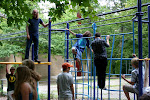
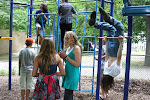
Will's students spill out of the classroom on a regular basis, and bounce happily around the school measuring, discussing, experimenting. You have to be careful coming out of the office sometimes in case you get a helium-powered gondola disputing your right-of-way. The children come into the office too, to get what they need. 'We want to measure you!' some of them told me a short while ago, and pulled me out to stand me up against the wall. It turned out they were trying to find out where in the world had an average yearly rainfall that was equivalent to my height. They write creative poems and stories that are uniquely their own. They write letters and essays on social justice that come from their hearts. They do independent projects that give them opportunities to delve deep into their own interests. They engage themselves in their work, and their studies are in large part self-studies, explorations of who they are and how they relate to their world on many levels. Over all this, Will's gentle presence supports, encourages, questions, and laughs with them. It's a very happy classroom.
I'm honored to have Will as a teacher in this school. He is an unusual man and an exceptional educator. He is a great example of what progressive education is about. He has been a guiding light to me for most of my SK teaching and administrative career, and his values have informed and inspired the whole school. I'll never forget the moment last year when I told one of our parents that he would be teaching her child. She turned to her daughter and said, 'You lucky, lucky girl.' The child looked puzzled, and the mother said, 'You've been taught by Joanna, by David, by Catie. Now you get to be taught by Will. They're all different, they're all bring their different passions to the table. What a great experience.' For me, that summed up our faculty as a whole: each one is different, each one has something new to offer the students who enter their classrooms, and each one offers his or her interests and inspirations wholeheartedly to the children.
Next profile: Susan Carpenter! Watch this space.
Saturday, April 25, 2009


Wednesday, April 1, 2009
Summers-Knoll Faculty Profiles: an introduction
Prospective parents inquiring about our school ask me from time to time; what is the teaching style at Summers-Knoll? The truth of the matter is that it mixes different styles, in no one single tradition, and that is a big part of our success. A former parent wrote to me the other day about her son, 'We're amazed, as are many of the teachers at his current school, at the depth of knowledge he has in relation to many of the other students at his school -- not just in math, but across the board.' The reason this student has this knowledge is that he has been taught by a variety of teachers - Susan, me, former SK teachers David Cyrus, Matt Perry and Catie Quist, and most recently by Will Purves. All these educators have very different styles: the combination of a variety of outstanding teachers makes an amazing, eclectic experience for a developing mind. Another parent mentioned to me when Will took over the 4-5 classroom last year how privileged her daughter was to have him as a teacher after the array of other spectacular teachers she had already been lucky enough to work with. What an opportunity to open new doors and think ever more deeply and creatively!
What all the teachers have in common is a commitment to honor each child as an individual and help them in their unique educational journey. Teachers love to work here because their own individuality is also honored and celebrated; each one is a passionate educator, a brilliant teacher, a loving guide, and each one has his or her own style of being in the classroom. They are free to educate in the best way that they, with their particular strengths, possibly can. They are trusted to respond to the children in their class and evolve the curriculum with those particular individuals in mind, with the flexibility to meet the needs of the children in the best way that they can. What I want to do over the next few posts is introduce you to each of our homeroom teachers as an educator, to give you some insights into their personal styles and what they are accomplishing in collaboration with your children. So watch this space! First up, Will Purves.
Friday, March 20, 2009
Moon Wolf
I'm sitting looking at a printout of the computer draft of 'Moon Wolf', the book that has been put together with a poem I wrote and a number of staggeringly beautiful illustrations created by our children under the guidance of Ruth Marks, Amelia's mother.
I want to ruminate a little on the process by which this book has come together. It has been a journey - one that is not ended yet, although the end is in sight. It started at the Ann Arbor Book Fair last May, with children stopping by the Summers-Knoll booth to make little books for themselves with pictures and stickers and words. Kim and I were staffing the booth, and of course we started making little books too. How could we resist?
Long story short: Kim made some little pictures and showed them to me. I improvised a little story to go with them, and a tiny book was born. But more than that, a seed of an idea was born which Kim nurtured and watered until quite recently. Then she said, 'Why don't you write a book and have the children illustrate it?'
Well, before I knew where I was, Melissa Bruzzano had picked up on the idea, and now I had two of them asking me what I was going to write. What I actually did was take the opening stanzas of a long narrative poem I had written some years before, and I offered that to the children. It was called 'Moon Wolf'.
Ruth Marks, who is an amazing professional artist, agreed to work with our children on the project, and all through the dreary month of February she and the students from the whole school made the winter seem brighter by working on enormous and largely collaborative pieces of art in different media. The K/1 children worked on washes and sweeps of textured color, colors of sunrises and midnights, backdrops for a wolf's journey. The 2/3 class was interested in the wolf's run through New York City, and they worked together on a huge cityscape, with tall buildings, streets and traffic. The 4/5s focused on landscapes: mountain ranges, polar ice, forests. Several of the children of all ages made portraits of my wolf. When everything was done, all the illustrations were taken in a huge pile to James Marks, who worked like a hero to sift through them all for the perfect images to create each page of text. He scanned them, photoshopped them, entered the text, and the book took shape.
Most of the images were developed by several children. When the selections were made, no one knew who had drawn what. Each illustration is a collaboration and a fusion of energy from each class. That is what makes them so special, and makes me so proud of the finished product. I feel as if every child's spirit is represented in the overall response.
There were many, many wonderful images to choose from, and relatively few pages on which to place them. Because of that, we are including a final page with a collage of images that we didn't have space for within the story itself. I hope that everyone will recognize something that they helped create.
The book is currently in to the printer, and we will receive a mock-up copy in due course. After alterations, it will be printed as a bound paperback book. We are selling it as a fundraiser for the school's Scholarship Fund, and the proceeds will be used to support student tuition for those who need it. Melissa has given out pre-order forms, but the actual launch of the book will be at Eudaimonia, our auction fundraiser at the Ann Arbor Art Center on May 9th. This event has really become an art-and-auction event: the children are in the process of making one-of-a-kind collaborative art pieces, Ruth and several other artists are donating unique and original works of art, and 'Moon Wolf' original illustrations will be up for auction too. It is a celebration of the creative spirit of our children and our whole community.
Thursday, March 19, 2009
Update on Reusable Shopping Bag Campaign
Some of you will remember that last year, Susan Carpenter and her class of social activists mounted a campaign to educate the community about the negative effects of plastic grocery bags. They put a huge ball of plastic grocery bag trash together and presented it to the Mayor at a City Council Meeting, showing eloquence. poise, self-confidence, and passion for their cause as they made a speech in front of the councilors and general public.
At that time, the Mayor told our students that plans were being drafted to ban plastic grocery bags in Ann Arbor. Then, just the other day, I received information through the Chamber of Commerce about a survey and focus groups that have been set up to gather public feedback on this issue. I have included the information at the end of this blog entry. If you would like to participate in the survey or in a focus group discussion session, the links and contact information are listed below.
I can't help hypothesizing that our fledgling 2nd and 3rd grade activists helped this process along. Our students can be very proud of themselves: they made their voices heard, and helped the decision-makers in our community understand the sincerity and commitment of our young people. Kudos to all of them!
| City of Ann Arbor Seeks Input on Shopping Bag Use |
| Survey & Two Business Focus Groups Tuesday, March 31 Zingerman's Road House 2501 Jackson Rd, Ann Arbor 8:30am - 9:30am & Thursday, April 2 Downtown Development Authority Office 150 S. Fifth Ave, Ste. 301, Ann Arbor 8:30am - 9:30am |
| City of Ann Arbor officials are considering policies that reduce the litter and waste from disposable shopping bags and encourage consumers to choose reusable shopping bags. The public is invited to provide input on a range of possible local shopping bag policies through online surveys and business focus group sessions. The comments received by early May will help shape future City Council actions. · Surveys are posted at www.a2gov.org/bags through April 30, 2009. Two variations of the survey are provided: one for general consumers; and a second designed for business owners, managers, and employees. · Interested business representatives are encouraged to attend one of two business focus group discussions to be held on Tuesday, March 31, 8:30am - 9:30am at Zingerman's Road House or on Thursday, April 2, 8:30am - 9:30am at the Downtown Development Authority (DDA) Office at 150 S. Fifth Ave., Suite 301. Pre-registration to these free sessions is appreciated. Light refreshments will be provided. Please RSVP to Katie at 734.794.6000 extension 43728 or to recycle@a2gov.org. · Requests for mailed copies of the survey and general comments on promoting reusable shopping bags are being handled by Katie at 734.794.6000 extension 43728 and through recycle@a2gov.org. |
Wednesday, February 11, 2009
Heal the Child Workshop
This workshop may be of interest to you. It is open to all. The information was sent to me by Amy Cherry, who is a Brain Gym practitioner with an organization called Learning through Movement.
To those who have children's best interest at heart. International presenter, Jon Bredal will be in Hastings, Michigan, March 13th and 14th , presenting his Heal the Child Program. Jon has been achieving outstanding results with children for over 20 years. He has worked with pioneers in the field of integrative movement, child development, kinesiology, and natural family systems healing.
Each one of us knows a child with ADD/ADHD, Autism, Dyslexia, Sensory, Speech Difficulties and other learning challenges. This is an opportunity to learn specific, step-by-step processes that get to the core of the challenges these children face. There are no prerequisites for the class and it is encouraged for parents, grandparents, teachers, OT's,PT's, counselors and anyone who has the interest to assist children in their full development and growth.
For more information and registration contact: Amy Cherry, M.S.Ed., amychry@sbcglobal.net 269-945-4568
Sunday, February 8, 2009
Creativity and Education
Please try to find fifteen minutes to watch Sir Ken Robinson's speech on the TED talks site (really wonderful mini-lectures on all kinds of subjects, for those of you who haven't discovered it yet). He discusses the need to foster children's innate creativity, and what that means. You can find it here.
It is a very timely reminder to all of us that intelligence is not only cerebral, that creativity springs from multiple kinds of intelligence, and that a creative approach to life and learning is essential for our society in these times of rapid change. Being locked into an educational system where mistakes are unacceptable, test scores are the measure of success, and students are directed down a narrow path with predefined required outcomes, ultimately destroys our chance of achieving excellence. It's a great speech, and also highly entertaining.
Saturday, January 24, 2009
The Pursuit of Happiness
Following the inauguration of a new President of the United States, what better time to reflect on the founding principles of this country? 'We hold these truths to be self evident, that all men [and women, incidentally] are created equal, that they are endowed by their Creator with certain unalienable Rights, that among these are Life, Liberty, and the Pursuit of Happiness'. Ah, goosebumps!
Last week it was brought to my attention that Jefferson (and the other signers of the Declaration of Independence) was basing his ideas of 'happiness' on Aristotle's 'Ethics', of which he owned a heavily annotated copy (in the original Greek, of course). This isn't any surprise - of course Jefferson studied Aristotle. It was expected at that time. What is more enlightening is to think about what Aristotle actually meant by the concept. He used the word 'eudaimonia', (which if you break it up must surely mean 'spirit of good'), and he interpreted it as human flourishing, self-actualization, knowing who you are and what you believe and having the courage to live according to your beliefs. That is the principle that was invoked in the Declaration of Independence, and interestingly enough it is also the principle we invoke at Summers-Knoll when we talk about a child's happiness. What we are seeking here is not the superficial happiness of every child at every minute of the day, a happiness brought about by having everything go smoothly, never coming into disagreement or irritation with another child, never having to try anything demanding or disagreeable, never having to experience conflict. To aim for that kind of happiness would be a huge disservice to our children. Watch Will's students responding to stories written by Sudanese refugees, or debating the meaning of life as they prepare for class. Watch Elaine's students racing to read books that will bring donations to kids in need. Watch Susan's class in math grappling with concepts of fairness (or unfairness) as they learn about probability. Watch them find power in helping each other through their 'Tribes' activities. Watch what they each come up with when they discover the intensity of Degas, or the ancient resonance of stories from Homer and Ovid. The happiness we're looking for here comes from self-actualization: the quest to become the most 'themselves' - and the best 'themselves' - that they can possibly be. We want to foster in our children the insatiable curiosity of the Elephant's Child (if you haven't read that story, it's a must. Look for it here), to help them grow to new awareness, new understanding, to develop in them the ability to think deeply, flexibly and creatively, to make connections, to explore their beliefs and have the courage to live accordingly, to discover passion in knowledge, skill, and service. (Albert Schweitzer famously said, 'The only ones among you who will be really happy are those who will have sought and found how to serve.' I think his notion of happiness fits right in here.)
If you have a chance, go here, and listen to what Ben Dunlap (president of Wofford College) has to say about the living of a full life. The people he describes and whose stories he tells did not necessarily live the most comfortable lives. They experienced suffering and injustice - more than we may be equipped to understand. Their happiness certainly didn't come from getting everything their own way. They found fulfillment through a passionate, empathetic engagement with life and an unfailing curiosity and zest for new experience. That's what we're shooting for here: the pursuit of happiness as an open-hearted exploration of life.
Subscribe to:
Posts (Atom)