


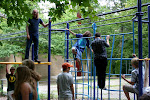
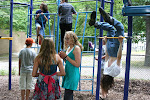
Graduation Day is one of my favorite celebrations of the year. The graduation students played and sang fabulous music, Karl spoke wise and witty words, the Kindergarteners recited sweetly, and there was much rejoicing. It is also a day that pulls at my heart. Today we celebrated the moving up and moving on of Saul, Denali, Lily, Jonathan and Ryan. We also celebrated the moving up to middle school of fifteen young 4th graders - awesome and wonderful creatures - but with our eighth graders we also have to say goodbye.
Each year I write poems for the graduating classes; a joint poem for the fourth grade and an individual poem for each of the eighth grade graduates. It is part of our ritual to have each child stand with me on the platform and listen to their poem. It is poignant moment for me, to have that opportunity to write for them and about them, and let them know how much they mean to us, and also at that same moment to send them off to new adventures.
Class of 2014, please know that you are loved. Come back and visit often.
Here are the poems:
Eighth Grade
Ode to Saul
O Saul, whose brain is like a city
Where buildings reach into the sky,
And streets make complicated patterns
Losing countless passers-by…
O Saul, the city of your brain
Is home to thoughts and contemplations,
Who ride their bikes to work each day
Through the streets of expectation.
Saul, the city is beautiful.
The reason why it is beautiful
Is that your heart is beautiful.
Over the city, the sun of kindness shines.
Ryan
Ryan throws down his gauntlet to the world.
“I challenge you, World!” he exclaims,
And the world accepts the challenge
But it knows it cannot manage
So it goes and packs its baggage
And runs away in shame.
Ryan climbs a mountain
Just because it’s there.
And the mountain throws ice storms at him,
And avalanches fall on him,
And sometimes lava pours on him,
But Ryan doesn’t care.
Ryan is the emperor
Of all that he surveys.
And he, like Alexander
(That Ancient Greek commander)
Seeks out new worlds to conquer
And earns eternal praise.
Denali
Denali is a lake of calm, calm water.
See how softly the reflections lie on the surface?
Not a ripple.
Not a wave.
Lake Denali smiles in the sunlight.
Take a small boat, and head across that water.
At some point you may feel, beneath the surface
Something ripple,
Someone wave,
Lake Denali is deep beneath the light.
There are all kinds of things that happen in that water;
Parties going on below the surface...
Laughter ripples,
Paintbrushes wave
With brilliant color that catches the light.
Denali is a lake of calm, calm water,
And under those reflections on the surface
Magic and mischief
Music and mayhem
Dance in the watery light.
Lily
Lily thinks
Lily thinks carefully
Lily thinks carefully and she acts.
Lily acts
Lily acts purposefully
Lily acts purposefully and she loves.
Lily loves
Lily loves with an open heart
Lily loves with an open heart and she laughs
Lily laughs
Lily laughs radiantly
Lily laughs radiantly and she sings
Lily sings
Lily sings wondrously
Lily sings wondrously and with life
Lily lives
Lily lives joyfully
Lily lives joyfully and with thought
Lily thinks carefully and she acts purposefully and she loves with an open heart and she laughs radiantly and she sings wondrously and she lives joyfully
Lily is in our hearts
Jonathan
Jonathan is an explorer,
And here’s how explorers play:
They find new paths no matter
How hard or rough the way.
Jonathan treks through the jungle,
Carving his own kind of track.
He pushes through vines and branches
and sometimes they push back.
Jonathan bounces up again,
And shakes off the leaves and dirt.
He smiles up into the sunlight
and shrugs away his hurt.
When there’s a monstrous fallen tree
That blocks the way ahead,
Jonathan jumps right over it
And bumps into the branch overhead.
Jonathan bounces back again,
And rubs his head with a smile.
He says, “I’ll find my own path,
And I’ll do it with personal style.”
Jonathan returns from the jungle,
With a fascinating map
Showing every place he tripped
And every place he bounced right up,
Because to get all the way through a jungle,
There are times when it makes you fumble,
And times when it makes you stumble,
For that is the way of a jungle,
And a true explorer jumps back up.
Jonathan is an explorer,
And as every explorer knows
The joy is in the adventure
And that’s how the spirit grows.
Fourth grade
The FourthGradeGrad Project (inspired by the Heidelberg Project)
In the town of Summers-Knoll
There is a lovely neighborhood
Called FourthGradeGraduate Avenue
With houses, gardens, woods.
There’s the Kit house. It opens on the woods, and all the trees reach in their branches until the whole house looks like a forest. Animals run in and out. The Kit house is connected to the Ariana house, which has a stream running through it, and a prairie. Butterflies dance abundantly.
The Clementine house is woven of bright yarns and fabrics, with a rooftop of folded paper and a garden that grows sequins and bright buttons. If you look in through the windows you will see that every room is painted like a different world.
The Oliver G house makes sounds. Different music comes out through every window, and as it comes out it turns into brightly colored words in crazy fonts that run all over the house. Nothing is the same for longer than a minute and a half. Every so often the front of the house folds down and reveals a stage, where brilliant comic plays are performed by Oliver G himself and his closest friends, to the delight of the neighborhood.
The Miriam house is also a performing house. The walls are made of moving dancers, and as they leap and pirouette the house shimmers and shifts and reforms, flowing and misty with gauze and silk. Miriam herself can be seen from time to time, poised en pointe on the balcony.
The Maddy house is a house of books. It is connected to the Becca house, also made of books, and between the two of them they have a maze that people can enter and read their way around until they are completely lost. People have been known to enter these houses and never come out again, living the rest of their lives inside the worlds of different books. Sometimes you meet a character coming out, who has accidentally stepped out of its book and is wandering around the maze too. I met Harry Potter himself, coming out of the Becca house. It was SO COOL. But he looked a little confused.
The Niko house is wound around with stories. The walls tell the stories, and the words grow into pictures on the outside. The house is surrounded by his friends, listening to the stories the walls tell and trying to avoid the zombies, who are always hanging around hoping to be part of the story.
There’s a whole block of houses covered in Magic cards. The Elliot house, the Andrés house and the Ben house are all thick with cards so you can’t see the walls or roof at all. The cards are constantly visiting or having contests of strength, with Pyromasters and Callers of Beasts and Legendary Creatures and Planeswalkers all playing tricks on each other. Sometimes the whole block bursts into flames for a second, or transforms into a dragon, and then Elliot or Ben or Andrés has to go and fix it so it doesn’t wreck the whole neighborhood.
The Owen house is a gigantic soccer ball. The door looks like the English flag, the Red Cross of St. George. If you ring the doorbell, it sounds like a huge crowd cheering, but if you open the door you will get bopped on the head by a soccer ball. Owen’s guests are famous soccer players from the history of the game, and they play all over the house all the time, so soccer balls are flying everywhere. Watch out.
The Oli S. house has been constructed out of Minecraft pieces. Oli goes on regular trips to other planets to gather construction materials. It’s an enormous house. It goes up and up, but also down and down into the earth, with endless new developments being made. If you actually want to talk to Oli you have to make an appointment. You can’t just drop by - his house goes on for miles and he may be a loooooong way away.
The Henry house is virtual. It is made of code. Henry reprograms it from time to time, whenever he wants a different look. Right now it is a mansion, but a couple of days ago I walked by and I’m sure it was a Winnebago. Henry programs gardens all around it, where he grows virtual vegetables which he cooks and eats for dinner. He shares them with a virtual groundhog who comes by and nibbles in the garden from time to time. (Note: Henry is not actually graduating from 4th grade - he is moving up into 4th grade. His contribution here is to feed Eva's horses, below.)
The Eva house is a stable. Horses come and go. The Eva house is full of hay and has a huge yard where the horses race each other and practice jumping over the fences out into the neighborhood. Sometimes they visit the Henry house, and help themselves to some good carrots or apples from the virtual garden, but they always complain that the food there isn’t very filling.
The Adri house is a mass of singing and acrobatics. It is a swirl of bright colors, and every few minutes it plays a fanfare. Ideas pop out through the windows and float away on the breeze like bubbles.
The neighborhood is beautiful,
Full of life and sound.
Thank you, Fourth Grade Graduates
We’ll be seeing you around!
Monday, June 9, 2014


Thursday, December 5, 2013
The timeline project
The Timeline Project is a service project that the 3rd and 4th graders have been working on to benefit the whole school. Spanning 10,000 years, the line will run all around the first floor of the school building, starting in the middle school commons outside the faculty lounge. It will run around the lunchroom, through the library, along the passage to the kindergarten classroom and back, past the courtyard and my office up to the art room, picking up again outside Chris's room, running along the passage and back into the lunchroom where it ends, here, at 2013. We've left plenty of space at the end here, as we know that current affairs will need plenty of real estate.

The whole school is invited to enter interesting dates and historical information as material comes up in their studies. We anticipate that the timeline will gradually become a collective record of the school's engagement with history. The measuring, calculating, cutting, inking, and taping has been an epic feat in its own right. The 3rd and 4th graders are honored to present this work to the school.

Saturday, November 16, 2013
Praising process and grit
It's not news that children develop better coping skills, internal motivation, self-esteem, skills and productivity when their efforts are recognized rather than their innate abilities ("Look how far your hard work has brought you," rather than "You're so smart!"). This article underlines the importance of this for girls in particular.
I'd emphasize this same point for gifted kids in particular, whose identity is in grave danger of being bound up with their intelligence, and who are often particularly susceptible to debilitating perfectionism. Students who can't get started on work, who procrastinate, have anxiety attacks, develop distraction techniques, cry, rush their work ("of course it's no good - I didn't try to make it good") - all these can be symptoms, not of lack of ability to do the work, but lack of ability to take the risk of not being perfect at first attempt. It is crucially important to support effort and celebrate the learning process that comes from mistakes.
When kids flunk on their assignments - and sometimes they do, even our little darlings - it's a great way to learn that their teacher trusts and respects them enough to allow them to learn from that and engage with the work again, properly. Effective learning takes effort, practice, and the knowledge that you are part of a network of people who care enough about you that they help you through avoidance and don't let you give in to insecurity.
Tuesday, November 5, 2013
Time for an update!
Another month has flown by, and there is more to share with you from an educational, programmatic perspective. Again, this is general information, not a call to action. Please feel free to skim to the parts that interest you.
The Alternative Athletic Association
As you know, Karl has connected with Upland Hills School in Oakland County, and The Friends School in Detroit - two warm, friendly, small independent schools with open hearts - to form an Alternative Athletic Association. The only league where schools write thank-you notes after competitions, the AAA continues in November with Summers-Knoll's middle schoolers welcoming visitors from Upland Hills, and getting on the bus to visit the Friends School. We don't have any scores to report, because thus far our games haven't lent themselves readily to statistics: ropes courses, gaga ball, parkour, and Calvinball.
This is a program that could expand to other schools in the future. At the moment we're keeping it small. The kids are having a blast, making new friends, and developing their team skills and sportsmanship in the process. We're enjoying the connection to other schools, and some great conversations are coming of it.
While we're on athletics, a completely different note:
PE Assistant
Adam Checkle, who has been so ably supporting Shan as PE assistant (a necessary role as Shan does so much work with the students off-site where the presence of a second adult is a crucial part of the picture) has moved on. His goal is to work as a classroom teacher, and he is actively pursuing that goal. We are sad to see him go, but of course we fully support him and wish him the very best in finding work that fits his needs.
This leaves us without a dedicated PE assistant at this point. Nick Taylor, my classroom assistant, is taking the time to support the PE program as a temporary measure. We do need to find another person, however, and will be searching for a really great, warm, active, person who can be Shan's assistant in this program. If you have thoughts, please don't hesitate to let me know.
The Odyssey
The play is cast, rehearsals have started, Karl is working like a demon with actors of all heights and ages, and excitement is swirling around the school. You've seen messages inviting you to get involved - this is truly a whole-community event. All faculty, staff, classes, parents, as well as their pets (no joke, there is a dog in this play) are encouraged to be a part of this vibrant experience. With seventy-two SK students in the cast, The Odyssey is a quintessential example of project-based learning. The kindergartners are the sheep; third and fourth graders are servants, suitors, sailors, shades, and swine; first and second graders are gods and goddesses; middle school students handle everybody else. The seventh and eighth graders are reading eleven different versions of the story--prose, poetry, children's versions, Caribbean vernacular, screenplays . . . . Through it all, they have been considering the distinction between quest and homecoming, and writing essays and creative pieces on that theme.
Our first production meeting, set up for any interested volunteers, will be on Wednesday, November 6, from 11:30 to 12:30. We are looking for assistance in designing and building costumes, putting the stage together, gathering amphorae, arrows, and other props, and wrangling those 72 actors.
A side effect of all this has been to make the younger children crazy for acting. Impromptu performances happen all the time (and more "promptu" ones also, like the performance of "The Little Old Lady Who Was Not Afraid of Anything, performed by Elaine's class for an audience of 3rd/4th graders and Kindergarteners).
Exhibitions
The 7th and 8th graders have been up to their ears in the past couple of weeks, presenting their Explorations projects. (Each theme culminates with individual projects. These projects are shown to peers, families, and faculty members in Exhibitions--two short lessons, packed with activity and newfound expertise.) Our set of Explorers Exhibitions ran from October 29 to November 5.
Among the twenty-four lessons taught were Ponce de Leon (in character); Mars rovers; life on Mars; the Silk Road (including attendees bartering Halloween candy); Eurycleia, Penelope's loyal maidservant; minimalism in music; tours of New York City, London, Antarctica, and Maastricht; early navigation and cartography; early cinema; and the first woman to go over Niagara Falls in a barrel. (Attendees were spared this experience.)
Our next round of Exhibitions will take place in the second week of January, engaging the theme of Identity.
Theme Work
We are embarking on the theme of Identity, and in many cases it is blending magically with our Exploration work. (One example: the Out of Eden walk undertaken by Paul Salopek explores the identity of human beings as well as the geography of their progress across the planet.) It also brings in opportunities for a delightful shift in focus. No matter what your background, chances are you are celebrating something around this time of year, and that this is meaningful to your family and your heritage. So as the holidays come closer, some of our classrooms will be inviting families in to share their own identity through celebration. At the same time, students will be looking at the science of identity - DNA and genetic studies of different kinds. Children will be reflecting on what makes them themselves in all kinds of different ways. Stay tuned with the blogs to see how this all develops.
Community Partnerships
The 5/6 class is engaged in a project based in County Farm Park, with the support of naturalists from the University of Michigan and the City of Ann Arbor. Each student is designing a study to collect and analyze data. (An example: one student is learning how to track deer activity throughout the park. As he finds evidence of deer trails, he'll add them to a map. He'll then use that data to try to determine their habits and diet, studying deer population that is specific to County Farm Park.) Each student will be tackling a wholly unique project in this fashion. Seed dispersal, water flow, evidence of glacial activity, squirrel behaviors, and fungi populations are a sampling of some of the other studies. The naturalists who are partnering with us offer our students the mentorship and example of experts from the community. Students plan to publish their studies at the end of the year. This is also tying in with work they are doing in Math, on contours and maps.
5th-8th grades continue to partner with the Sweetland Center for Writing - thank you to Anne Gere for the continuing inspiration and support.
The 3rd/4th grade "Walks with Experts" series continues. So far our visitors have included Tom Mansell (sound artist - thank you to Christine Hume for the connection), Theresa and Brad Angelini (the architects who designed our school), A. Van Jordan (poet - thank you to Peter Ho Davies for the connection), and this week we are looking forward to Amy Kulper (Amy is an architect but also a historian, and will be focusing on history for her walk). Coming up we have a botanist and a police officer with his dog. We anticipate that this series will run all through the year.
Our own Christopher Matthews, father of Eliza Braunschneider in 1st grade, has written an astonishing poem about the journey of Lewis and Clark, which a couple of different classes (1st/2nd and 3rd/4th) will be working with. It's a huge enrichment and a great gift to the school to have parents who share their talents with us so generously. It builds on the work the younger kids have been doing on Lewis and Clark for the Exploration theme (lots of hands-on activities like making candles, Great Plains stew, moccasins, and preserved fruit, as well as excursions into the field to make notes and to take samples of flowers and leaves like The Corps of Discovery did).
On a similar poetic note, Christine Hume has arranged for visual poet Douglas Kearney to do a workshop with our 3rd and 4th graders on November 6th - poetry abounds in our elementary school. This promises to be enormously exciting.
We had a soul-stirring experience with Mark Stone and Dan Piccolo, who ran workshops and performed an interactive World Music concert for all our students. It was vibrant, beautiful, compelling stuff - thank you to Josh for making it happen. Mark and Dan also stayed for lunch to chat with our faculty, and we were joined by Jenny Koppera, a theatre professional with an interest in global theatre for kids, and James Chaffers, an architect who has worked in Europe and Africa, and who was a guiding light in the development of the Martin Luther King Memorial in Washington DC (thank you, Amy Kulper, for the connection). It was a lovely, lovely lunch with many interesting conversations which I know are continuing to happen between teachers and our guests. It will be fascinating to see where this might lead.
Kindergarteners have forged an on-going relationship with the University of Michigan Hospital Child Care Centre, where several of our children attended preschool and our own Val used to teach. This gives our smallest students the opportunity to be the big kids, and to offer love and guidance to the preschoolers when they visit them at the UMHCCC.
Music
Josh is starting a series of relaxed evenings to share the children's music with the community. We are calling them Music Cafe evenings, and the first one, focusing on middle school, will be on November 21st. You should have received an email from Karen with details on this. Josh's goal here is to break down the barrier between music at home and music at school, and have the children identify as musicians whose musical passion is integrated into every part of their lives. As such, they are encouraged to bring music from outside school to perform at the Music Cafe.
Math
As you all know, the math books are only part of the picture, providing structure and necessary practice. Math abounds with activities, also, that bring excitement and deeper understanding to the subject. 3rd and 4th graders have started on some programming work, with the majority studying the Tynkers program, and a small group studying robotics with Dr. George with a view to training others later. All classes are doing work that brings math alive, from cutting up potatoes and studying County Farm Park contour maps, to cube nets, to calendar games at kindergarten level that support developing readers as well as budding mathematicians.
EBs
Always fun, always exciting, always popular, EBs are in full swing after only one week, as we have changed the format to twice-a-week sessions. It's a lovely way to mix up the classes (my poetry EB has 3rd-7th grade participants) and the atmosphere that pervades the building as children head to their different EBs has a unique kind of energy to it. The buzz is palpable. EBs this session include Photography, Bread Baking (and culture), Paper Airplanes (and rockets), and Forensics for the little ones, and Poetry, Gardening, Card Games, Africa, and Science FIction for the older ones. Great stuff.
EcoFair
Costumes for EcoFair were, as ever, imaginative, creative, adorable, and amazing. A big thanks to you and your children for making this celebration so much fun and so memorable again this year. The parade was a blast. Next year, weather permitting, we will take it outside and walk around Arbor Hills Crossing mall with it. The world needs to know!
That's it for now - please do check your teacher's blog for more details, and read the blogs that other teachers write, too. There's some really interesting stuff happening in this school, and it's just not possible to capture it all here. I'm grateful to the faculty, the children, and all of you for the opportunity to work in such a vibrant place - much of this is on-going, but when you think that this represents a month at SK, you can perhaps see how magical it is to work in such a place. Please continue to bring your thoughts, expertise, connections and vitality to share with us - you are a vital part of the energy that drives this school.
Thank you all for your support and warmth, and for sharing your children with us. Please let me know if you have any questions at all.
The Alternative Athletic Association
As you know, Karl has connected with Upland Hills School in Oakland County, and The Friends School in Detroit - two warm, friendly, small independent schools with open hearts - to form an Alternative Athletic Association. The only league where schools write thank-you notes after competitions, the AAA continues in November with Summers-Knoll's middle schoolers welcoming visitors from Upland Hills, and getting on the bus to visit the Friends School. We don't have any scores to report, because thus far our games haven't lent themselves readily to statistics: ropes courses, gaga ball, parkour, and Calvinball.
This is a program that could expand to other schools in the future. At the moment we're keeping it small. The kids are having a blast, making new friends, and developing their team skills and sportsmanship in the process. We're enjoying the connection to other schools, and some great conversations are coming of it.
While we're on athletics, a completely different note:
PE Assistant
Adam Checkle, who has been so ably supporting Shan as PE assistant (a necessary role as Shan does so much work with the students off-site where the presence of a second adult is a crucial part of the picture) has moved on. His goal is to work as a classroom teacher, and he is actively pursuing that goal. We are sad to see him go, but of course we fully support him and wish him the very best in finding work that fits his needs.
This leaves us without a dedicated PE assistant at this point. Nick Taylor, my classroom assistant, is taking the time to support the PE program as a temporary measure. We do need to find another person, however, and will be searching for a really great, warm, active, person who can be Shan's assistant in this program. If you have thoughts, please don't hesitate to let me know.
The Odyssey
The play is cast, rehearsals have started, Karl is working like a demon with actors of all heights and ages, and excitement is swirling around the school. You've seen messages inviting you to get involved - this is truly a whole-community event. All faculty, staff, classes, parents, as well as their pets (no joke, there is a dog in this play) are encouraged to be a part of this vibrant experience. With seventy-two SK students in the cast, The Odyssey is a quintessential example of project-based learning. The kindergartners are the sheep; third and fourth graders are servants, suitors, sailors, shades, and swine; first and second graders are gods and goddesses; middle school students handle everybody else. The seventh and eighth graders are reading eleven different versions of the story--prose, poetry, children's versions, Caribbean vernacular, screenplays . . . . Through it all, they have been considering the distinction between quest and homecoming, and writing essays and creative pieces on that theme.
Our first production meeting, set up for any interested volunteers, will be on Wednesday, November 6, from 11:30 to 12:30. We are looking for assistance in designing and building costumes, putting the stage together, gathering amphorae, arrows, and other props, and wrangling those 72 actors.
A side effect of all this has been to make the younger children crazy for acting. Impromptu performances happen all the time (and more "promptu" ones also, like the performance of "The Little Old Lady Who Was Not Afraid of Anything, performed by Elaine's class for an audience of 3rd/4th graders and Kindergarteners).
Exhibitions
The 7th and 8th graders have been up to their ears in the past couple of weeks, presenting their Explorations projects. (Each theme culminates with individual projects. These projects are shown to peers, families, and faculty members in Exhibitions--two short lessons, packed with activity and newfound expertise.) Our set of Explorers Exhibitions ran from October 29 to November 5.
Among the twenty-four lessons taught were Ponce de Leon (in character); Mars rovers; life on Mars; the Silk Road (including attendees bartering Halloween candy); Eurycleia, Penelope's loyal maidservant; minimalism in music; tours of New York City, London, Antarctica, and Maastricht; early navigation and cartography; early cinema; and the first woman to go over Niagara Falls in a barrel. (Attendees were spared this experience.)
Our next round of Exhibitions will take place in the second week of January, engaging the theme of Identity.
Theme Work
We are embarking on the theme of Identity, and in many cases it is blending magically with our Exploration work. (One example: the Out of Eden walk undertaken by Paul Salopek explores the identity of human beings as well as the geography of their progress across the planet.) It also brings in opportunities for a delightful shift in focus. No matter what your background, chances are you are celebrating something around this time of year, and that this is meaningful to your family and your heritage. So as the holidays come closer, some of our classrooms will be inviting families in to share their own identity through celebration. At the same time, students will be looking at the science of identity - DNA and genetic studies of different kinds. Children will be reflecting on what makes them themselves in all kinds of different ways. Stay tuned with the blogs to see how this all develops.
Community Partnerships
The 5/6 class is engaged in a project based in County Farm Park, with the support of naturalists from the University of Michigan and the City of Ann Arbor. Each student is designing a study to collect and analyze data. (An example: one student is learning how to track deer activity throughout the park. As he finds evidence of deer trails, he'll add them to a map. He'll then use that data to try to determine their habits and diet, studying deer population that is specific to County Farm Park.) Each student will be tackling a wholly unique project in this fashion. Seed dispersal, water flow, evidence of glacial activity, squirrel behaviors, and fungi populations are a sampling of some of the other studies. The naturalists who are partnering with us offer our students the mentorship and example of experts from the community. Students plan to publish their studies at the end of the year. This is also tying in with work they are doing in Math, on contours and maps.
5th-8th grades continue to partner with the Sweetland Center for Writing - thank you to Anne Gere for the continuing inspiration and support.
The 3rd/4th grade "Walks with Experts" series continues. So far our visitors have included Tom Mansell (sound artist - thank you to Christine Hume for the connection), Theresa and Brad Angelini (the architects who designed our school), A. Van Jordan (poet - thank you to Peter Ho Davies for the connection), and this week we are looking forward to Amy Kulper (Amy is an architect but also a historian, and will be focusing on history for her walk). Coming up we have a botanist and a police officer with his dog. We anticipate that this series will run all through the year.
Our own Christopher Matthews, father of Eliza Braunschneider in 1st grade, has written an astonishing poem about the journey of Lewis and Clark, which a couple of different classes (1st/2nd and 3rd/4th) will be working with. It's a huge enrichment and a great gift to the school to have parents who share their talents with us so generously. It builds on the work the younger kids have been doing on Lewis and Clark for the Exploration theme (lots of hands-on activities like making candles, Great Plains stew, moccasins, and preserved fruit, as well as excursions into the field to make notes and to take samples of flowers and leaves like The Corps of Discovery did).
On a similar poetic note, Christine Hume has arranged for visual poet Douglas Kearney to do a workshop with our 3rd and 4th graders on November 6th - poetry abounds in our elementary school. This promises to be enormously exciting.
We had a soul-stirring experience with Mark Stone and Dan Piccolo, who ran workshops and performed an interactive World Music concert for all our students. It was vibrant, beautiful, compelling stuff - thank you to Josh for making it happen. Mark and Dan also stayed for lunch to chat with our faculty, and we were joined by Jenny Koppera, a theatre professional with an interest in global theatre for kids, and James Chaffers, an architect who has worked in Europe and Africa, and who was a guiding light in the development of the Martin Luther King Memorial in Washington DC (thank you, Amy Kulper, for the connection). It was a lovely, lovely lunch with many interesting conversations which I know are continuing to happen between teachers and our guests. It will be fascinating to see where this might lead.
Kindergarteners have forged an on-going relationship with the University of Michigan Hospital Child Care Centre, where several of our children attended preschool and our own Val used to teach. This gives our smallest students the opportunity to be the big kids, and to offer love and guidance to the preschoolers when they visit them at the UMHCCC.
Music
Josh is starting a series of relaxed evenings to share the children's music with the community. We are calling them Music Cafe evenings, and the first one, focusing on middle school, will be on November 21st. You should have received an email from Karen with details on this. Josh's goal here is to break down the barrier between music at home and music at school, and have the children identify as musicians whose musical passion is integrated into every part of their lives. As such, they are encouraged to bring music from outside school to perform at the Music Cafe.
Math
As you all know, the math books are only part of the picture, providing structure and necessary practice. Math abounds with activities, also, that bring excitement and deeper understanding to the subject. 3rd and 4th graders have started on some programming work, with the majority studying the Tynkers program, and a small group studying robotics with Dr. George with a view to training others later. All classes are doing work that brings math alive, from cutting up potatoes and studying County Farm Park contour maps, to cube nets, to calendar games at kindergarten level that support developing readers as well as budding mathematicians.
EBs
Always fun, always exciting, always popular, EBs are in full swing after only one week, as we have changed the format to twice-a-week sessions. It's a lovely way to mix up the classes (my poetry EB has 3rd-7th grade participants) and the atmosphere that pervades the building as children head to their different EBs has a unique kind of energy to it. The buzz is palpable. EBs this session include Photography, Bread Baking (and culture), Paper Airplanes (and rockets), and Forensics for the little ones, and Poetry, Gardening, Card Games, Africa, and Science FIction for the older ones. Great stuff.
EcoFair
Costumes for EcoFair were, as ever, imaginative, creative, adorable, and amazing. A big thanks to you and your children for making this celebration so much fun and so memorable again this year. The parade was a blast. Next year, weather permitting, we will take it outside and walk around Arbor Hills Crossing mall with it. The world needs to know!
That's it for now - please do check your teacher's blog for more details, and read the blogs that other teachers write, too. There's some really interesting stuff happening in this school, and it's just not possible to capture it all here. I'm grateful to the faculty, the children, and all of you for the opportunity to work in such a vibrant place - much of this is on-going, but when you think that this represents a month at SK, you can perhaps see how magical it is to work in such a place. Please continue to bring your thoughts, expertise, connections and vitality to share with us - you are a vital part of the energy that drives this school.
Thank you all for your support and warmth, and for sharing your children with us. Please let me know if you have any questions at all.
Monday, November 4, 2013
ADHD event
Here's a great opportunity to attend a program on ADHD, free and open to all,presented by Dr. Charles Krasnow at the WISD. Dr. Krasnow is a local psychiatrist specializing in pediatric and adolescent psychiatry, and his talk promises to be useful and interesting. Details can be found on the Washtenaw Learning Disabilities Association Upcoming Events page.

Wednesday, October 9, 2013
A month has passed already!
We've got off to an exciting start to the year on a bunch of fronts. Here are some highlights:
Themes
We've reached the middle of our first theme - Explorations - and it's clear that this is a theme that is going to last forever. Faculty discussions about project collaborations are reaching into upcoming themes (Identity, Cities, Mythology) and linking constantly with Explorations as a vehicle. Exploration is a key element of the SK learning experience, and will always be a part of the process.
The school play - The Odyssey - is a prime example of project-based learning in action. The middle school students have researched this story in many forms, and rehearsals are about to begin. More on the play below. Students at this level are about ready to jump into independent projects based in their studies from the first month of the theme.
The Odyssey has led to some other adventurous work around journeys. Kids are writing their own epics, and will be illustrating and, we hope, turning them into books. In maybe more unusual ways, though, we are connecting with travelers of the body and mind who bring unique insights to our children. Paul Salopek, the journalist who is doing the Out of Eden walk will be skyping with our students; sound artists, policemen, poets and explorers of other genres will be walking with them and sharing their individual ways of looking at their environment with us; Josh, Imogen, Monica, Tracy, George, Shan - all our brilliant team (I love these people) are exploring with the kids and planning collaborations with homeroom teachers to bring far-reaching projects to life. Across the board, from Lewis and Clark to space exploration, there is so much to tell and learn here. Read your teacher's blogs. And if they are behind on them, harass them about it. Harass me. :) We all get caught up in the doing, and the telling can get neglected.
Science
Dr. George is working on a - truly - amazing system for our greenhouse, to ensure that it is heated throughout the winter to extend our growing season. All of George's blog is worth reading - fascinating stuff - but the greenhouse system is best explained here.
You'll see (if you read his blog) that the middle school students are engaging on the science behind this along with George. On that subject, I'd like to take a moment to clarify George's role this year. You've given me feedback that the changes are confusing; here's (I hope) a more comprehensive explanation.
George's title this year is Scientist-In-Residence. This was a moniker he and I dreamed up because it seemed most in keeping with the inspirational, enriching work that he does with the children. Last year, each class went to the science room to work with George for an hour each week. He also did science club three times a week. We saw the way that science club ideas and projects caught fire in the children's imaginations, and George and I discussed how we could make this happen best in the context of the classroom. Out original vision, when we hired George two years ago, was that he would bring inspirational science as an extension to the work being done in the homeroom, and in the process inspire the teachers as well as the children to love science and engage with it in creative, central ways. So we are re-committing to that vision.
This is the way we have fashioned it. The homeroom teachers teach science. At middle school level we are exceptionally fortunate to have two trained science teachers, Jason and Sam, as part of the team, and they are heading up the science/STEM program for the 5th-8th students. For all our homeroom teachers, George is a partner and a resource. So, for example, I have been working on an understanding of atoms and elements with my class, and George has been working individually and with small groups to support and enrich every child in developing an experiment or demonstration of their chosen element. Because we have flexibility of time, George is able to join us, or take children to the science room, when we need it rather than when the schedule arbitrarily demands. George is able to bring his magic to science in a way that keeps it in the context of homeroom studies but also takes it to other dimensions, and do it in a way that gives every child his undivided attention.
George also brainstorms with the faculty and comes up with larger group projects. The greenhouse heating project is a case in point. George has been working with middle schoolers on understanding thermodynamics, and he has been planting tomato and cucumber seeds for our winter harvest with both the 3rd/4th grade groups. We are brainstorming together how to collaborate on an aquaponics system. The work is meaningful because it is uniquely George's brilliance, couched in the larger context of the homeroom experience.
George is available to all homeroom groups and all teachers in this way. He is of course also still doing science club for the enthusiasts who just can't get enough science, and ultimately the students working with him during the club will have the opportunity - under his guidance - to teach their findings to their homeroom groups.
That was a lot of explaining. Thank you for bearing with me!
Music
Josh is arranging for for world percussion expert Mark Stone to come to the school and do a performance and a workshop. Mark is absolutely amazing and will play, demonstrate and talk about a large range of instruments and music from Africa, India, and a few other places. Mark will also be leading workshops for small groups when he comes in. It's a really exciting opportunity.
Josh is doing a music workshop for teachers! Yes, he is! Thursday lunchtimes we are going to be happy bunch of noisemakers, and it is going to be so much fun. Thank you, Josh, for giving us the chance to be musical learners with you.
(By the way, Josh is doing FABULOUS work in music. I have kids singing in my classroom because of him, just for the joy of it. But they are composing, too, engaging with different instruments, experiencing the joy of collaborative creation, and the older kids are bringing in their own saxophones, flutes, violins etc, and developing ensemble skills with those instruments too. The music room is active, vibrant, noisy and delectable, and the kids are loving it. Just thought I'd say.)
Middle School
We're introducing a sex education curriculum, Our Whole Lives (http://www.uua.org/re/owl/), to our middle school classes. This is an impressively well-designed program with a strong emphasis on self-worth, responsibility, social justice, and thoughtful decision-making. It was developed by the Unitarian Church, although it is an entirely secular curriculum. Rachel Goldberg, our new Director of Camps and Extended Learning, has joined our middle school teaching team to provide female mentorship and leadership for our girls. It is our great good fortune that Deb Dean-Ware, mother of Josiah in 1st grade, is extensively experienced and trained in this program, and is trained to train. She has given her time and energy generously to make sure that the middle school team, including Rachel, are properly prepared to teach. The 5th/6th program is comparatively short and will start later in the year. Karl and Rachel have already started some very thoughtful work with our oldest kids, taking them on a retreat to the UP (to a place very kindly lent to us by Karl's parents, Bill and Sheila Sikkenga) last week to give ample space and time for foundational reflection and discussion.
The University of Michigan Sweetland Center for Writing is partnering with our middle school students to develop writing workshop skills and techniques. This has been inspiring and challenging for our kids, and they have stepped up to the plate with enthusiasm. Huge thanks to Anne Gere (Denali's mother) for masterminding this connection.
Karl Sikkenga has started the initial stages of our school play, which this year will be based on Homer's epic of exploration, The Odyssey. The main characters will be played by middle school students, and there will be opportunities to take part in group scenes for the younger students also. Every class in the school will be involved in some way, whether acting, set-painting, or some other contribution, and every teacher collaborates under Karl's guidance in this process. This is a fitting follow-up to last year's highly successful Gilgamesh, and fits exceptionally well with our themes of Exploration, Identity, and Mythology. (Coincidence? I think not.) It's also a fantastic example of the collaborative approach taken by our faculty. The play will be performed on December 5th, 6th and 7th, so please mark your calendars now. Middle school students should plan to be available for all three of these performances.
Sam Hirschman, Jason's 5th/6th grade homeroom partner (who is new to his role although not new to Summers-Knoll), has been pioneering a new model of teaching math at middle school level. Sam is a highly experienced math and science teacher, and we have altered that math model to allow maximum access to his exceptional teaching. Sam is leading all three math groups at middle school level, from the latter stages of the Singapore curriculum and into Algebra and beyond. Sam is also teaching the most advanced of our elementary math groups. Thank you, Sam.
Elementary School
Nate Ayers has started working with both 3rd/4th classes. Nate is a professional permaculturist who first established a relationship with Summers-Knoll two years ago. Nate has been discussing monocultures, polycultures, and bio-mimicry with the children so far, using our own County Farm Park as his science lab. He's a brilliant educator and scientist, and we're looking forward to working with him as he continues to blow our students' minds. Thank you to Chris Swinko for establishing and fostering this relationship.
In time-honored tradition, naturalist Faye Stoner from County Farm Park has been working with our 1st and 2nd grade students. Faye typically walks in the woods with our kids three times a year, watching the changing seasons and examining the activity of the natural world. See Susan Carpenter's blog post about it here. Many thanks to Faye for her lovely work.
Our kindergarten class ended up being 13 children strong this year - one more than we normally anticipate. Because of this, Shan Cook is working with Val in a supporting role this year, thereby realizing a dream of working with kindergarten kids. Thank you, Shan, for bringing your great energy, love, and experience to the kindergarten room.
My thanks go to the entire teaching team for their teamwork, huge hearts and brilliant brains. It is an absolute privilege to be working with these people. Our returning teachers are, of course, fabulous. Our new additions to the team - Mary Swain, Sam Hirschman, Monica Wilson, Josh Grekin, Rachel Goldberg in her Our Whole Lives role, and Shiyu Nitsos have all thrown themselves into the spirit and life of our school with enthusiasm, generosity and great teaching chops. It feels as if they have been part of our family forever. Thank you, all of you, for everything you bring.
And, lastly, a HUGE shout-out to the operations team, under the guidance of Fran Loosen. You people are bringing our school to new heights, and it's a total joy to me to be focusing on curriculum, faculty, and my own teaching, knowing that operations are in such good hands. Huzzah! and THANK YOU!
Themes
We've reached the middle of our first theme - Explorations - and it's clear that this is a theme that is going to last forever. Faculty discussions about project collaborations are reaching into upcoming themes (Identity, Cities, Mythology) and linking constantly with Explorations as a vehicle. Exploration is a key element of the SK learning experience, and will always be a part of the process.
The school play - The Odyssey - is a prime example of project-based learning in action. The middle school students have researched this story in many forms, and rehearsals are about to begin. More on the play below. Students at this level are about ready to jump into independent projects based in their studies from the first month of the theme.
The Odyssey has led to some other adventurous work around journeys. Kids are writing their own epics, and will be illustrating and, we hope, turning them into books. In maybe more unusual ways, though, we are connecting with travelers of the body and mind who bring unique insights to our children. Paul Salopek, the journalist who is doing the Out of Eden walk will be skyping with our students; sound artists, policemen, poets and explorers of other genres will be walking with them and sharing their individual ways of looking at their environment with us; Josh, Imogen, Monica, Tracy, George, Shan - all our brilliant team (I love these people) are exploring with the kids and planning collaborations with homeroom teachers to bring far-reaching projects to life. Across the board, from Lewis and Clark to space exploration, there is so much to tell and learn here. Read your teacher's blogs. And if they are behind on them, harass them about it. Harass me. :) We all get caught up in the doing, and the telling can get neglected.
Science
Dr. George is working on a - truly - amazing system for our greenhouse, to ensure that it is heated throughout the winter to extend our growing season. All of George's blog is worth reading - fascinating stuff - but the greenhouse system is best explained here.
You'll see (if you read his blog) that the middle school students are engaging on the science behind this along with George. On that subject, I'd like to take a moment to clarify George's role this year. You've given me feedback that the changes are confusing; here's (I hope) a more comprehensive explanation.
George's title this year is Scientist-In-Residence. This was a moniker he and I dreamed up because it seemed most in keeping with the inspirational, enriching work that he does with the children. Last year, each class went to the science room to work with George for an hour each week. He also did science club three times a week. We saw the way that science club ideas and projects caught fire in the children's imaginations, and George and I discussed how we could make this happen best in the context of the classroom. Out original vision, when we hired George two years ago, was that he would bring inspirational science as an extension to the work being done in the homeroom, and in the process inspire the teachers as well as the children to love science and engage with it in creative, central ways. So we are re-committing to that vision.
This is the way we have fashioned it. The homeroom teachers teach science. At middle school level we are exceptionally fortunate to have two trained science teachers, Jason and Sam, as part of the team, and they are heading up the science/STEM program for the 5th-8th students. For all our homeroom teachers, George is a partner and a resource. So, for example, I have been working on an understanding of atoms and elements with my class, and George has been working individually and with small groups to support and enrich every child in developing an experiment or demonstration of their chosen element. Because we have flexibility of time, George is able to join us, or take children to the science room, when we need it rather than when the schedule arbitrarily demands. George is able to bring his magic to science in a way that keeps it in the context of homeroom studies but also takes it to other dimensions, and do it in a way that gives every child his undivided attention.
George also brainstorms with the faculty and comes up with larger group projects. The greenhouse heating project is a case in point. George has been working with middle schoolers on understanding thermodynamics, and he has been planting tomato and cucumber seeds for our winter harvest with both the 3rd/4th grade groups. We are brainstorming together how to collaborate on an aquaponics system. The work is meaningful because it is uniquely George's brilliance, couched in the larger context of the homeroom experience.
George is available to all homeroom groups and all teachers in this way. He is of course also still doing science club for the enthusiasts who just can't get enough science, and ultimately the students working with him during the club will have the opportunity - under his guidance - to teach their findings to their homeroom groups.
That was a lot of explaining. Thank you for bearing with me!
Music
Josh is arranging for for world percussion expert Mark Stone to come to the school and do a performance and a workshop. Mark is absolutely amazing and will play, demonstrate and talk about a large range of instruments and music from Africa, India, and a few other places. Mark will also be leading workshops for small groups when he comes in. It's a really exciting opportunity.
Josh is doing a music workshop for teachers! Yes, he is! Thursday lunchtimes we are going to be happy bunch of noisemakers, and it is going to be so much fun. Thank you, Josh, for giving us the chance to be musical learners with you.
(By the way, Josh is doing FABULOUS work in music. I have kids singing in my classroom because of him, just for the joy of it. But they are composing, too, engaging with different instruments, experiencing the joy of collaborative creation, and the older kids are bringing in their own saxophones, flutes, violins etc, and developing ensemble skills with those instruments too. The music room is active, vibrant, noisy and delectable, and the kids are loving it. Just thought I'd say.)
Middle School
We're introducing a sex education curriculum, Our Whole Lives (http://www.uua.org/re/owl/), to our middle school classes. This is an impressively well-designed program with a strong emphasis on self-worth, responsibility, social justice, and thoughtful decision-making. It was developed by the Unitarian Church, although it is an entirely secular curriculum. Rachel Goldberg, our new Director of Camps and Extended Learning, has joined our middle school teaching team to provide female mentorship and leadership for our girls. It is our great good fortune that Deb Dean-Ware, mother of Josiah in 1st grade, is extensively experienced and trained in this program, and is trained to train. She has given her time and energy generously to make sure that the middle school team, including Rachel, are properly prepared to teach. The 5th/6th program is comparatively short and will start later in the year. Karl and Rachel have already started some very thoughtful work with our oldest kids, taking them on a retreat to the UP (to a place very kindly lent to us by Karl's parents, Bill and Sheila Sikkenga) last week to give ample space and time for foundational reflection and discussion.
The University of Michigan Sweetland Center for Writing is partnering with our middle school students to develop writing workshop skills and techniques. This has been inspiring and challenging for our kids, and they have stepped up to the plate with enthusiasm. Huge thanks to Anne Gere (Denali's mother) for masterminding this connection.
Karl Sikkenga has started the initial stages of our school play, which this year will be based on Homer's epic of exploration, The Odyssey. The main characters will be played by middle school students, and there will be opportunities to take part in group scenes for the younger students also. Every class in the school will be involved in some way, whether acting, set-painting, or some other contribution, and every teacher collaborates under Karl's guidance in this process. This is a fitting follow-up to last year's highly successful Gilgamesh, and fits exceptionally well with our themes of Exploration, Identity, and Mythology. (Coincidence? I think not.) It's also a fantastic example of the collaborative approach taken by our faculty. The play will be performed on December 5th, 6th and 7th, so please mark your calendars now. Middle school students should plan to be available for all three of these performances.
Sam Hirschman, Jason's 5th/6th grade homeroom partner (who is new to his role although not new to Summers-Knoll), has been pioneering a new model of teaching math at middle school level. Sam is a highly experienced math and science teacher, and we have altered that math model to allow maximum access to his exceptional teaching. Sam is leading all three math groups at middle school level, from the latter stages of the Singapore curriculum and into Algebra and beyond. Sam is also teaching the most advanced of our elementary math groups. Thank you, Sam.
Elementary School
Nate Ayers has started working with both 3rd/4th classes. Nate is a professional permaculturist who first established a relationship with Summers-Knoll two years ago. Nate has been discussing monocultures, polycultures, and bio-mimicry with the children so far, using our own County Farm Park as his science lab. He's a brilliant educator and scientist, and we're looking forward to working with him as he continues to blow our students' minds. Thank you to Chris Swinko for establishing and fostering this relationship.
In time-honored tradition, naturalist Faye Stoner from County Farm Park has been working with our 1st and 2nd grade students. Faye typically walks in the woods with our kids three times a year, watching the changing seasons and examining the activity of the natural world. See Susan Carpenter's blog post about it here. Many thanks to Faye for her lovely work.
Our kindergarten class ended up being 13 children strong this year - one more than we normally anticipate. Because of this, Shan Cook is working with Val in a supporting role this year, thereby realizing a dream of working with kindergarten kids. Thank you, Shan, for bringing your great energy, love, and experience to the kindergarten room.
My thanks go to the entire teaching team for their teamwork, huge hearts and brilliant brains. It is an absolute privilege to be working with these people. Our returning teachers are, of course, fabulous. Our new additions to the team - Mary Swain, Sam Hirschman, Monica Wilson, Josh Grekin, Rachel Goldberg in her Our Whole Lives role, and Shiyu Nitsos have all thrown themselves into the spirit and life of our school with enthusiasm, generosity and great teaching chops. It feels as if they have been part of our family forever. Thank you, all of you, for everything you bring.
And, lastly, a HUGE shout-out to the operations team, under the guidance of Fran Loosen. You people are bringing our school to new heights, and it's a total joy to me to be focusing on curriculum, faculty, and my own teaching, knowing that operations are in such good hands. Huzzah! and THANK YOU!
Monday, November 26, 2012
testing for the future?
It's great to see that there are people putting serious energy into making a viable alternative to the SAT test that pays attention to critical and creative thinking. Click here for an interesting article.
Sunday, November 11, 2012
autonomy, mastery, and purpose
Dan Pink's book Drive first led to the language we share with our community to describe our goals for children as they learn: that we provide an environment in which autonomy, mastery, and purpose are present so the students are motivated to learn joyfully, and teachers are motivated to give their best to their teaching. Click here to link to a video where Dan Pink describes this same idea. Enjoy.
Tuesday, October 9, 2012
more about testing
As we continue to probe the best way to assess the kind of learning our children should be doing in school - learning that supports creative thinking, problem-solving, community connections, and other complex forms of thinking and acting - Alfie Kohn continues to remind us of our priorities. Click here to read his recent article: Schooling Beyond Measure.
Sunday, October 7, 2012
working with the faculty
On Friday the children stayed home from school, and the teachers and I dug into some intense and really important work.
We spent the morning thinking about the current position of the school and our hopes and plans for the direction in which it is going. We thought back on some of our history, and teachers who have been with us for a decade shared their perspective of the journey we have taken, while teachers new this year explained some of what they were experiencing as newly-minted members of the team.
We talked about the challenges the new building has brought us, as well as the benefits. We flagged the dangers of disconnection amongst the team, given that the geography of our space no longer forces us to see each other constantly. We discussed areas within the school building that have not really found their purpose yet, or their spirit of place. We recognized the intense effort that has gone and continues to go into the transition from one building to another, and everything that implies for our identity as a school and our way of being with the children and with each other. We were grateful for the fact that, in the midst of changes, we have reaffirmed our commitment to nature and outdoor exploration for the children.
Looking to the future, we talked about maintaining the vision of a school where the freedom, exploration, and joy of childhood are honored and supported. We discussed the need for systems that are organic enough to maintain flexibility, structures that have windows for unique opportunities and situations, and road maps from which we can usefully deviate. We invoked meaningful, purposeful work, an environment integrated with nature, and the deep connection of our children with teachers and community. We discussed our founder's initial vision of the school as a place where children would be technologically adept in a way that supported social and emotional development and remained in tune with nature and real world experience. A metaphorical image that resonated strongly was one of children running barefoot in the woods with computers.
In small groups, we discussed strategies to support our current need for greater connection with each other, so that we can work together more strongly on a common vision for the future. We made commitments to deeper and more intentional collaborative work, and dedicated time to that purpose. We brainstormed options for creating more time that would be flexible enough to support this need. We discussed our developing understanding of how the space in (and outside of) our new building works and how we can use it more effectively.
The afternoon was dedicated to an ongoing discussion of student assessments; what can be assessed, what can't, how we can assess work and development in a way that truly supports education, is manageable, and is most meaningful to the student, the teacher, and parents. This is an extremely complex subject, and one that we will be dedicating time and thought to in an ongoing fashion indefinitely. Assessment strategies will be refined and revised as the world changes around us and we understand ever better how to produce a really useful result.
It was a fruitful and exhausting day, as professional development days should be. I am looking forward to continuing these discussions and plans with faculty and parents into the future.
We spent the morning thinking about the current position of the school and our hopes and plans for the direction in which it is going. We thought back on some of our history, and teachers who have been with us for a decade shared their perspective of the journey we have taken, while teachers new this year explained some of what they were experiencing as newly-minted members of the team.
We talked about the challenges the new building has brought us, as well as the benefits. We flagged the dangers of disconnection amongst the team, given that the geography of our space no longer forces us to see each other constantly. We discussed areas within the school building that have not really found their purpose yet, or their spirit of place. We recognized the intense effort that has gone and continues to go into the transition from one building to another, and everything that implies for our identity as a school and our way of being with the children and with each other. We were grateful for the fact that, in the midst of changes, we have reaffirmed our commitment to nature and outdoor exploration for the children.
Looking to the future, we talked about maintaining the vision of a school where the freedom, exploration, and joy of childhood are honored and supported. We discussed the need for systems that are organic enough to maintain flexibility, structures that have windows for unique opportunities and situations, and road maps from which we can usefully deviate. We invoked meaningful, purposeful work, an environment integrated with nature, and the deep connection of our children with teachers and community. We discussed our founder's initial vision of the school as a place where children would be technologically adept in a way that supported social and emotional development and remained in tune with nature and real world experience. A metaphorical image that resonated strongly was one of children running barefoot in the woods with computers.
In small groups, we discussed strategies to support our current need for greater connection with each other, so that we can work together more strongly on a common vision for the future. We made commitments to deeper and more intentional collaborative work, and dedicated time to that purpose. We brainstormed options for creating more time that would be flexible enough to support this need. We discussed our developing understanding of how the space in (and outside of) our new building works and how we can use it more effectively.
The afternoon was dedicated to an ongoing discussion of student assessments; what can be assessed, what can't, how we can assess work and development in a way that truly supports education, is manageable, and is most meaningful to the student, the teacher, and parents. This is an extremely complex subject, and one that we will be dedicating time and thought to in an ongoing fashion indefinitely. Assessment strategies will be refined and revised as the world changes around us and we understand ever better how to produce a really useful result.
It was a fruitful and exhausting day, as professional development days should be. I am looking forward to continuing these discussions and plans with faculty and parents into the future.
Sunday, September 23, 2012
Why Kids Need Schools to Change
As the new year gets underway, I want to share this article with you. Click here to read about "Challenge Success", a Stanford program working to help schools change to incorporate more progressive approaches. Progressive schools are still seen as experimental over a century after John Dewey published his theory of progressive education; it does seem, however, that the world is starting to catch on. All good stuff.
Wednesday, June 6, 2012
Today was Graduation Day, and may have been my favorite graduation of any that have happened so far. A good part of that can be attributed to the fact that I didn't have to say goodbye to any of the children - they were all graduating into our middle school program, so they will all remain part of this community in the coming year. Part of it was also due to the fact that we "graduated" the whole school from the old building to the new one on Platt Road - and by an unlooked for blessing of fate, we were able to all swarm into the building and explore it informally. It did good things for my heart to see that lovely space with kids in it, as it is meant to be.
As usual, I wrote poems for the graduating students. This time I changed the format. Rather than writing a poem each for them (which will now happen when they graduate from middle school to high school at the end of their 8th grade) I wrote a collective poem for each group - the 4th graders moving into 5th (the start of middle school at Summers-Knoll) and the 5th graders who were new to us this year and had therefore not had a graduation ceremony yet. Here are the poems for the children. For the 4th grade:
The 4th Grade Solar System
Yesterday Venus crossed the sun.
A small black circle moving with purpose
A determined little thing
Sailing a sea of fire.
Once every hundred and sixty years this happens.
All across the world people stopped
And watched in awe.
We also have planets, right here with us, crossing the
Enormous span of the sun:
Planet Matthew is a portal to a new dimension,
Where dragons and strange beasts of legend
Are real and red with life.
Planet Noah moves around the sun
Three times faster than any other celestial body
And from time to time his orbit
Takes a loop out to visit other stars.
If you visit Planet Anna you will find
A world as rich in life as our earth is,
Where numbers fly like birds across the wind,
And words with wide eyes scurry in the woods.
On Planet Laurea the rocks themselves
Are deep with thought and bright with
Diamonds of imagination. Sometimes the stones get together and
Put on a little play.
There are two Planet Henrys in this solar system,
Scientifically known as A and K.
Planet A pushes his orbit out. Every trip around the sun
Takes him further outward into space, pushing, pushing out,
Conquering the black vastness, filling it with light.
Planet K loops up and down, round and round
Rollercoastering along its path
Leaving a comet-trail of sparks that,
When you look at it carefully, through a telescope, you will see
It is made of words longer than any other words
The universe has ever heard.
Planet Melissa is composed, not of rock, but
Of volatile elements, dancing and
Occasionally erupting with a sound of laughter. Colors mix and swirl
Kaleidoscopically.
Astronauts who have landed on Planet Lee report
The ground has voice, and each step you take
It speaks to you and tells you strange
And revelatory facts about the universe.
They have come back to earth and written books
Full of the knowledge that they gained,
Walking on Planet Lee.
The last one in this solar system, Planet Alexandra,
Glows with radiance from its inner core
Of sun. It compresses and expands like breath,
Focusing in, radiating out, focusing in, radiating out,
Steady on its orbit like a bird flying home.
Together in this solar system they all dance and shine,
Each planet circling, moving on its course,
Making a pattern full of wondrous
Worlds that weave together.
This will never happen quite this way again,
These planets, ever-evolving, ever-unique,
Crossing the sun, moving on their way
Are once in an eternity.
Venus has nothing on it.
And for the 5th grade:
Brains Going Places
All year long,
In a very small room,
In an odd little place
With a basement gloom,
A few young brains
With warmth and light
Melted the walls,
Took off in flight.
Cory’s brain did this in a very literal way. It devised an aircraft, with special brain-transporting capabilities. The aircraft had everything a brain could want: a bank of knowledge-capsules for nourishment, communication portals for those moments when it wanted to check in with other brains, an intensely streamlined shape for faster-than-light travel, and plenty of hard-core weaponry in case of an alien attack. Cory’s brain went far in this aircraft. No one but Cory is quite sure how far.
When Cory’s brain
Burst through the wall
It left a hole
Five feet tall.
Other brains
Peered through the hole
And found their own way
To their goal.
Isobel’s brain took a basket of knowledge and set off through the woods to the Kindergarten house. It had made the knowledge into especially tasty treats: bookberry preserves, historical honey, scientific syrup and better-thinking butter. It entered the Kindergarten house where all the little brains were clamoring for food, and it fed them delicious spoonfuls of knowledge from the basket. When everything had been gobbled up, Isobel’s brain took all the kindergarten brains into the sun-filled woods to play.
Isobel’s brain
Shared and taught
And doing that
Found what it sought.
Other brains
Tried other roads,
Made their way
In their own modes.
Mikey’s brain set about turning the earth into a Medieval castle built entirely out of sugar cubes. Once the whole planet had been re-formed in this way, Mike’s brain invested it with a system of peace and justice so that the castle became a bastion of respect and social equity. Everyone in the world came and lived in Mike’s brain’s castle, practiced friendship, and licked sugar off the walls.
Mike’s brain is set
To change the earth,
Ensure world peace,
Increase our worth.
Another brain
Slipped through the wall
Spread its wings,
Reached up tall.
Aristea’s brain layered the world with multiple dimensions like sheets of shimmering, iridescent silk, each layer glowing softly with different opportunities. One dimension was populated exclusively by spaghetti. Others were portals to lands filled with strange beings, colors never seen before, angels with many wings, words that took shape and became alive. Aristea’s brain moved from dimension to dimension, and as it moved, the silken worlds grew to infinite possibilities.
Aristea
Has a brain
Full of sunshine,
Full of rain.
All the brains
Within that room
(The small room filled
With basement gloom)
Know how to fly,
Know how to soar;
They learn the world
And make it more.
As usual, I wrote poems for the graduating students. This time I changed the format. Rather than writing a poem each for them (which will now happen when they graduate from middle school to high school at the end of their 8th grade) I wrote a collective poem for each group - the 4th graders moving into 5th (the start of middle school at Summers-Knoll) and the 5th graders who were new to us this year and had therefore not had a graduation ceremony yet. Here are the poems for the children. For the 4th grade:
The 4th Grade Solar System
Yesterday Venus crossed the sun.
A small black circle moving with purpose
A determined little thing
Sailing a sea of fire.
Once every hundred and sixty years this happens.
All across the world people stopped
And watched in awe.
We also have planets, right here with us, crossing the
Enormous span of the sun:
Planet Matthew is a portal to a new dimension,
Where dragons and strange beasts of legend
Are real and red with life.
Planet Noah moves around the sun
Three times faster than any other celestial body
And from time to time his orbit
Takes a loop out to visit other stars.
If you visit Planet Anna you will find
A world as rich in life as our earth is,
Where numbers fly like birds across the wind,
And words with wide eyes scurry in the woods.
On Planet Laurea the rocks themselves
Are deep with thought and bright with
Diamonds of imagination. Sometimes the stones get together and
Put on a little play.
There are two Planet Henrys in this solar system,
Scientifically known as A and K.
Planet A pushes his orbit out. Every trip around the sun
Takes him further outward into space, pushing, pushing out,
Conquering the black vastness, filling it with light.
Planet K loops up and down, round and round
Rollercoastering along its path
Leaving a comet-trail of sparks that,
When you look at it carefully, through a telescope, you will see
It is made of words longer than any other words
The universe has ever heard.
Planet Melissa is composed, not of rock, but
Of volatile elements, dancing and
Occasionally erupting with a sound of laughter. Colors mix and swirl
Kaleidoscopically.
Astronauts who have landed on Planet Lee report
The ground has voice, and each step you take
It speaks to you and tells you strange
And revelatory facts about the universe.
They have come back to earth and written books
Full of the knowledge that they gained,
Walking on Planet Lee.
The last one in this solar system, Planet Alexandra,
Glows with radiance from its inner core
Of sun. It compresses and expands like breath,
Focusing in, radiating out, focusing in, radiating out,
Steady on its orbit like a bird flying home.
Together in this solar system they all dance and shine,
Each planet circling, moving on its course,
Making a pattern full of wondrous
Worlds that weave together.
This will never happen quite this way again,
These planets, ever-evolving, ever-unique,
Crossing the sun, moving on their way
Are once in an eternity.
Venus has nothing on it.
And for the 5th grade:
Brains Going Places
All year long,
In a very small room,
In an odd little place
With a basement gloom,
A few young brains
With warmth and light
Melted the walls,
Took off in flight.
Cory’s brain did this in a very literal way. It devised an aircraft, with special brain-transporting capabilities. The aircraft had everything a brain could want: a bank of knowledge-capsules for nourishment, communication portals for those moments when it wanted to check in with other brains, an intensely streamlined shape for faster-than-light travel, and plenty of hard-core weaponry in case of an alien attack. Cory’s brain went far in this aircraft. No one but Cory is quite sure how far.
When Cory’s brain
Burst through the wall
It left a hole
Five feet tall.
Other brains
Peered through the hole
And found their own way
To their goal.
Isobel’s brain took a basket of knowledge and set off through the woods to the Kindergarten house. It had made the knowledge into especially tasty treats: bookberry preserves, historical honey, scientific syrup and better-thinking butter. It entered the Kindergarten house where all the little brains were clamoring for food, and it fed them delicious spoonfuls of knowledge from the basket. When everything had been gobbled up, Isobel’s brain took all the kindergarten brains into the sun-filled woods to play.
Isobel’s brain
Shared and taught
And doing that
Found what it sought.
Other brains
Tried other roads,
Made their way
In their own modes.
Mikey’s brain set about turning the earth into a Medieval castle built entirely out of sugar cubes. Once the whole planet had been re-formed in this way, Mike’s brain invested it with a system of peace and justice so that the castle became a bastion of respect and social equity. Everyone in the world came and lived in Mike’s brain’s castle, practiced friendship, and licked sugar off the walls.
Mike’s brain is set
To change the earth,
Ensure world peace,
Increase our worth.
Another brain
Slipped through the wall
Spread its wings,
Reached up tall.
Aristea’s brain layered the world with multiple dimensions like sheets of shimmering, iridescent silk, each layer glowing softly with different opportunities. One dimension was populated exclusively by spaghetti. Others were portals to lands filled with strange beings, colors never seen before, angels with many wings, words that took shape and became alive. Aristea’s brain moved from dimension to dimension, and as it moved, the silken worlds grew to infinite possibilities.
Aristea
Has a brain
Full of sunshine,
Full of rain.
All the brains
Within that room
(The small room filled
With basement gloom)
Know how to fly,
Know how to soar;
They learn the world
And make it more.
Saturday, April 7, 2012
Open House April 22nd
In our new building, paint is going onto the walls. The reading nooks looking out onto the courtyard are warm with color. The sun comes in through the huge windows and skylights, and every way you look there are views to the trees outside. The flexible learning spaces - the common areas, breakout spaces, front porches for the classrooms, the open library space - are everything I hoped they would be. The music and drama studio, the science lab, the art room, the classrooms; they are all spacious, bright, gorgeous places. Soon they will be alive with children and the hum of projects and great ideas.
Our middle school classroom for the fall is currently full to bursting at sixteen students. We've decided to open a second classroom at this age, so that we can simultaneously broaden the social opportunities for the kids and reduce the number of students in each room; maximize both the social and the academic possibilities. Project-based learning is powerful for students at this age, and I'm excited about the idea of offering our programs more widely.
We're holding an Open House for prospective parents at the new building on April 22nd from 1-3pm. Unfortunately we can't have students in there until the building is completely finished, but kids can be dropped off at our current building on Manchester while the Open House is happening. Students are very welcome to make an appointment to discuss our middle school programs with me, and there will be opportunities to look around the building from June on.
Please spread the word about the Open House! We'd love families with middle school students to know more about the options our programs offer, and we still have a few spots left in our elementary grades. So tell all your friends - it's not too late to find out more. Details are on our website.
Our middle school classroom for the fall is currently full to bursting at sixteen students. We've decided to open a second classroom at this age, so that we can simultaneously broaden the social opportunities for the kids and reduce the number of students in each room; maximize both the social and the academic possibilities. Project-based learning is powerful for students at this age, and I'm excited about the idea of offering our programs more widely.
We're holding an Open House for prospective parents at the new building on April 22nd from 1-3pm. Unfortunately we can't have students in there until the building is completely finished, but kids can be dropped off at our current building on Manchester while the Open House is happening. Students are very welcome to make an appointment to discuss our middle school programs with me, and there will be opportunities to look around the building from June on.
Please spread the word about the Open House! We'd love families with middle school students to know more about the options our programs offer, and we still have a few spots left in our elementary grades. So tell all your friends - it's not too late to find out more. Details are on our website.
Monday, December 12, 2011
follow-up thought on creativity: how do you test it?
This is always a fascinating topic. I was moved to muse on it further today, coming across this quote:
"The McNamara Fallacy:
The first step is to measure whatever can be easily measured. This is okay as far as it goes.
The second step is to disregard that which can't be measured or give it an arbitrary quantitative value. This is artificial and misleading.
The third step is to presume that what can't be measured easily really isn't very important. This is blindness.
The fourth step is to say that that which can't be easily measured really doesn't exist. This is suicide."
Daniel Yankelovich, quoted by Adam Smith in Supermoney.
What level has standardized testing reached on this scale? Has creativity become devalued because it is hard to test? How can we do better?
"The McNamara Fallacy:
The first step is to measure whatever can be easily measured. This is okay as far as it goes.
The second step is to disregard that which can't be measured or give it an arbitrary quantitative value. This is artificial and misleading.
The third step is to presume that what can't be measured easily really isn't very important. This is blindness.
The fourth step is to say that that which can't be easily measured really doesn't exist. This is suicide."
Daniel Yankelovich, quoted by Adam Smith in Supermoney.
What level has standardized testing reached on this scale? Has creativity become devalued because it is hard to test? How can we do better?
creativity and conformity
Here's something interesting to think about. We are all about nurturing creativity in (and out of) the classroom. We want to enhance the learning experience for each individual child, allowing each one to develop their abilities and potential in the way that's right for them.
And we want to do this in the context of the group, with respect for others, promoting responsibility, collaboration, and good citizenship.
THe first is apparently all about individuality, the second all about conformity. Intensely creative children tend to relish individuality, and tend to resist conformity. How do we do that dance where we support the individuality with understanding of the traits that highly creative children bring to the process, without sacrificing the needs of the community of which they are a part?
Read an interesting blog on the subject here.
And we want to do this in the context of the group, with respect for others, promoting responsibility, collaboration, and good citizenship.
THe first is apparently all about individuality, the second all about conformity. Intensely creative children tend to relish individuality, and tend to resist conformity. How do we do that dance where we support the individuality with understanding of the traits that highly creative children bring to the process, without sacrificing the needs of the community of which they are a part?
Read an interesting blog on the subject here.
Saturday, October 29, 2011
technology: the raging debate
Technology has always been a bit of a thorny problem for an educator. At Summers-Knoll we share the point of view expressed by Jane Healey in her book, "Failure to Connect". (You can find an excerpt here for an example of her reasoning.) Her statement, "The best multimedia, interactive environment is still the real world," resonates with us and informs our approach, especially with the younger children.
Does that mean there is no place for technology? Clearly, students are excited by the extensive opportunities offered by computers and interactive software. There's a huge and understandable desire on the part of their teachers to harness that excitement. There's also a huge pressure on parents to feed their children with technological entertainment. ("But Mom! It promotes hand-eye coordination!") And just as the world of technology is enormous and complex, so are the arguments that surround it. Essential tool or poisonous creator of ADHD? Thought-promoter or thought-destroyer? Social promoter or the end of human connection? There's a lot of attraction and a lot of anxiety to navigate.
It has to be all in the choices and the applications: educational technology comes in many forms. Some are useful and some are emphatically not. Some can be used creatively and with original thinking; some cannot. It doesn't help that this is a powerful, multi-billion dollar industry with a lot at stake, and the research is conflicting and flawed by self-interest. Here's an insightful New York Times article that describes some of the vagaries of educational software research.
At Summers-Knoll we'll continue to be wary. We'll avoid technology with the younger children. We'll choose software with the older students that demands independent thought, analysis and creativity. And we'll continue to watch and question.
Does that mean there is no place for technology? Clearly, students are excited by the extensive opportunities offered by computers and interactive software. There's a huge and understandable desire on the part of their teachers to harness that excitement. There's also a huge pressure on parents to feed their children with technological entertainment. ("But Mom! It promotes hand-eye coordination!") And just as the world of technology is enormous and complex, so are the arguments that surround it. Essential tool or poisonous creator of ADHD? Thought-promoter or thought-destroyer? Social promoter or the end of human connection? There's a lot of attraction and a lot of anxiety to navigate.
It has to be all in the choices and the applications: educational technology comes in many forms. Some are useful and some are emphatically not. Some can be used creatively and with original thinking; some cannot. It doesn't help that this is a powerful, multi-billion dollar industry with a lot at stake, and the research is conflicting and flawed by self-interest. Here's an insightful New York Times article that describes some of the vagaries of educational software research.
At Summers-Knoll we'll continue to be wary. We'll avoid technology with the younger children. We'll choose software with the older students that demands independent thought, analysis and creativity. And we'll continue to watch and question.
Monday, October 17, 2011
Wild Swan Theatre
This morning I stopped by the WIld Swan rehearsal space and watched the actors brushing up on their current play, "Once Upon a Time". I was struck all over again by the magic, not just of these high-energy, charismatic actors, but also of the mirror-acting done by the sign language interpreter. She acts alongside the regular actors, using body, face and movement as well as hand signs to express the words and characters of the play, so that children who have hearing problems can engage with the action of the plot without having to look to the side of the stage for the sign interpretation. It's fascinating to watch. It's also a great message of inclusiveness for hearing kids.
Here's information about "Once Upon a TIme":
Once Upon a Time
Family friendly, for Pre-K and up!
Thursday, October 20, 10:00am
Friday, October 21, 10:00am and 1:00pm
Saturday, October 22, 11:00am
Wild Swan Theater opens its 32nd Anniversary Season of bringing the finest theater to Michigan's families with Once Upon A Time, an engaging collection of classic stories and songs!
Once Upon a Time offers three familiar and friendly tales, imaginatively staged, and is the perfect introduction to theater for young children, ages 3-9. In true Wild Swan style, three performers (Sandy Ryder, Jeremy Salvatori, and Michelle Trame Lanzi) and musician David Mosher create all the magic inherent in these timeless stories, making this first time theater experience unforgettable. Jamie Fidler, an American Sign Language Performer, rounds out our cast.
This lively and fast paced production begins with a sweet and funny version of “The Three Billy Goats Gruff.” Children will delight in the telling of "The Billy Goats Gruff" where the silly but very hungry troll is outwitted by three clever mountain goats.
“Reynard the Fox,” the second story in this collection, provides ample opportunity for audience participation. The children become Reynard’s shadow and echo, giving him all he needs to trick his animal friends. This delightful story ends with the audience getting a chance to trick Reynard!
Our final story is the classic tale of “The Three Little Pigs.” These are some spunky pigs that enjoy riling up the wolf. The three houses that each pig builds are beautifully and magically created, helping to make this story fun and funny at the same time.
Live music arranged and performed by David Mosher heightens the beauty, suspense, and humor inherent in these timeless tales. Besides playing throughout the stories, he also plays several songs which tell wonderful stories on their own. We are honored to have David who has been named “Outstanding Acoustic Instrumentalist” several years running by Detroit Metro Times.
Jamie Fidler’s signing is seamlessly woven into the action, adding another layer of clarity and depth to the stories while bringing the beauty of sign language to our stage. Backstage '"touch tours" and audio-description are available for blind audience members. Please call (734) 995-0530 for reservations for these services.
This production is part of Wild Swan Theater’s “Kid’s Classic Series” for ages 3-9. Our Classic Series introduces young theater goers to the joys of live theater. Gently told tales in a story-theater style provide first time audiences with the thrill of seeing favorite stories come to life with easy to follow plots, lively staging and physical humor, imaginative costumes and props, and many opportunities for audience participation.
Tickets $12 for adults, $8 for children and seniors
Discounts available for groups of 10 or more; $3 lap passes available for patrons under 2 years of age.
Purchase and Information: (734) 995-0530 or www.wildswantheater.org
Accessibility reservations: (734) 995-0530
Wheel chair seating
American Sign Language Interpreting
Audio-Description and Backstage Touch Tours
All performances at Towsley Auditorium, Morris Lawrence Building, Washtenaw Community College, 4800 E. Huron River Drive.
Here's information about "Once Upon a TIme":
Once Upon a Time
Family friendly, for Pre-K and up!
Thursday, October 20, 10:00am
Friday, October 21, 10:00am and 1:00pm
Saturday, October 22, 11:00am
Wild Swan Theater opens its 32nd Anniversary Season of bringing the finest theater to Michigan's families with Once Upon A Time, an engaging collection of classic stories and songs!
Once Upon a Time offers three familiar and friendly tales, imaginatively staged, and is the perfect introduction to theater for young children, ages 3-9. In true Wild Swan style, three performers (Sandy Ryder, Jeremy Salvatori, and Michelle Trame Lanzi) and musician David Mosher create all the magic inherent in these timeless stories, making this first time theater experience unforgettable. Jamie Fidler, an American Sign Language Performer, rounds out our cast.
This lively and fast paced production begins with a sweet and funny version of “The Three Billy Goats Gruff.” Children will delight in the telling of "The Billy Goats Gruff" where the silly but very hungry troll is outwitted by three clever mountain goats.
“Reynard the Fox,” the second story in this collection, provides ample opportunity for audience participation. The children become Reynard’s shadow and echo, giving him all he needs to trick his animal friends. This delightful story ends with the audience getting a chance to trick Reynard!
Our final story is the classic tale of “The Three Little Pigs.” These are some spunky pigs that enjoy riling up the wolf. The three houses that each pig builds are beautifully and magically created, helping to make this story fun and funny at the same time.
Live music arranged and performed by David Mosher heightens the beauty, suspense, and humor inherent in these timeless tales. Besides playing throughout the stories, he also plays several songs which tell wonderful stories on their own. We are honored to have David who has been named “Outstanding Acoustic Instrumentalist” several years running by Detroit Metro Times.
Jamie Fidler’s signing is seamlessly woven into the action, adding another layer of clarity and depth to the stories while bringing the beauty of sign language to our stage. Backstage '"touch tours" and audio-description are available for blind audience members. Please call (734) 995-0530 for reservations for these services.
This production is part of Wild Swan Theater’s “Kid’s Classic Series” for ages 3-9. Our Classic Series introduces young theater goers to the joys of live theater. Gently told tales in a story-theater style provide first time audiences with the thrill of seeing favorite stories come to life with easy to follow plots, lively staging and physical humor, imaginative costumes and props, and many opportunities for audience participation.
Tickets $12 for adults, $8 for children and seniors
Discounts available for groups of 10 or more; $3 lap passes available for patrons under 2 years of age.
Purchase and Information: (734) 995-0530 or www.wildswantheater.org
Accessibility reservations: (734) 995-0530
Wheel chair seating
American Sign Language Interpreting
Audio-Description and Backstage Touch Tours
All performances at Towsley Auditorium, Morris Lawrence Building, Washtenaw Community College, 4800 E. Huron River Drive.
Saturday, October 15, 2011
the value of play
When I was a child, I spent hours and hours building houses out of branches and leaves and "living" in them. I dressed up continually, trying on different personalities from different times and places, many of them not real to anyone but me. I made potions out of flower petals and rainwater, and whole worlds out of moss and twigs and tiny plants. I spent a huge amount of time outdoors, alone and with friends, with no play set but the trees and grass of the common area that backed my family's yard.
Watching our children at Summers-Knoll when they play in our playground or in the woods of County Farm Park takes me right back there. The games that the older children have been playing over at their temporary digs at the Good Shepherd are endlessly fascinating. They have no slide, no swing set, just a rather intriguing space with grass, paths and a wildish area of native plants and marshy ground. The children -all of them- have turned it into a complex system of real estate which they buy and sell, rent and share in nuanced and ever-changing ways. The lack of a formal play structure is as nothing in the face of their blazing imagination.
Here's an article from The Atlantic, giving yet another reminder of the importance of play to developing minds. Enjoy.
Watching our children at Summers-Knoll when they play in our playground or in the woods of County Farm Park takes me right back there. The games that the older children have been playing over at their temporary digs at the Good Shepherd are endlessly fascinating. They have no slide, no swing set, just a rather intriguing space with grass, paths and a wildish area of native plants and marshy ground. The children -all of them- have turned it into a complex system of real estate which they buy and sell, rent and share in nuanced and ever-changing ways. The lack of a formal play structure is as nothing in the face of their blazing imagination.
Here's an article from The Atlantic, giving yet another reminder of the importance of play to developing minds. Enjoy.
Subscribe to:
Posts (Atom)